top of page
vues-3d-tissue-maps-background.png

Visualization and User Experience Seminars

VUES
on Spatial Biology

About

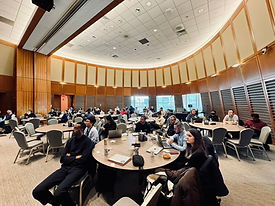
This seminar series brings together leading researchers and tool developers at the intersection of biomedical imaging, spatial omics, and high-dimensional data analysis. As biological and clinical research increasingly generates complex, large-scale, and spatially resolved datasets, the ability to visualize and interpret this information has become essential.


Topics span deep learning-guided image segmentation, dimensionality reduction for spatially structured data, GPU-accelerated volume rendering, and human-AI interaction. Speakers present novel computational frameworks as well as new visualization techniques designed to enhance interpretability and usability for non-technical users.


Applications range from spatial transcriptomics and cancer imaging to neurobiology and fluid dynamics, offering insights relevant to both scientific discovery and clinical translation. The series highlights the growing synergy between visual analytics, machine learning, and biomedical research, with an emphasis on reproducibility, accessibility, and translational potential. 

Upcoming Events

placeholder.png

Christian La France

Allen Institute for Immunology

May 19, 2026

Visualizing the Transcriptome at Unprecedented Depth with Atera

Past Events

Mirana Ramialison

Heart Foundation Future Leader Fellow

placeholder.png

End-to-end 3D multi-slice spatial transcriptomics analysis with VR-Omics/CELLestial

April 21, 2026

Jiwoon Park

Harvard Medical School and Weill Cornell Medicine

placeholder.png

Building the Spatial Atlas of Human Anatomy: Consortium Science, Al Integration, and the Path to Clinical Spatial Omics

March 17, 2026

David Horsfall

Newcastle University

placeholder.png

BioNGFF: Aligning Web Visualisation with Emerging OME-Zarr Features

February 17, 2026

Mark Keller

Harvard Medical School

placeholder.png

EasyVitessce: Adding interactivity to Scverse single-cell and spatial biology plots

November 18, 2025

Eric Mörth

Harvard Medical School

placeholder.png

3D Tissue Maps: Unlocking 3D context in spatial biology through interoperable and performant data formats and visual exploration tools

November 18, 2025

Eunice Lee

Duke University

placeholder.png

InterSCellar: Surface-Based Cell Neighborhood and Interaction Volume Analysis in 3D Spatial Omics

November 18, 2025

Simon Warchol

Harvard University

placeholder.png

SEAL: Spatially-resolved Embedding Analysis with Linked Imaging Data

October 21, 2025

Valentina Matos Romero

Johns Hopkins University

placeholder.png

CODAvision: Best Practices and a User-Friendly Interface for Rapid, Customizable Segmentation of Medical Images

May 20, 2025

VUES Conference at Harvard Medical School

Nine speakers across the areas of data generation, computational analysis, and interactive visualization of spatial omics and imaging data.

placeholder.png

The Future of 3D Tissue Maps

March 11, 2025

Peter Bankhead, PhD

Centre for Genomic & Experimental Medicine at Institute of Genetics and Cancer

placeholder.png

Interacting with big images: Lessons (still being) learned with QuPath

February 18, 2025

Stefan Lengauer, Peter Waldert, Tobias Schreck

2024 Bio+MedVis Challenge Winners

placeholder.png

Droplets: A Marker Design for visually enhancing Local Cluster Association

January 21, 2025

David Hagele, Yuxuan Tang, Daniel Weiskopf

2024 Bio+MedVis Challenge Winners

placeholder.png

Visual Composition Data Analytics for Spatial Transcriptomics

January 21, 2025

Thomas Höllt, PhD

Computer Graphics and Visualization Group, TU Delft

placeholder.png

Visual Analytics for Spatially Resolved High-Dimensional Data - Methods and Applications in Biology

November 19, 2024

Stephen Taylor, PhD

Wellcome Centre for Human Genetics, University of Oxford

placeholder.png

Democratizing the analysis and visualization of omics datasets using Multi-Dimensional Viewer

October 14, 2024

Markus Hadwiger, PhD

King Abdullah University of Science and Technology

placeholder.png

Scalable GPU-Based Visualization of Large Volume Data

September 17, 2024

Ambrose Carr, Adam Taylor, Ino de Bruijin, Becky Reamy

Multiple Affiliations

placeholder.png

Panel discussion: Reflections on building spatial biology data portals and resources

March 19, 2024

Michael Rose

Michigan Translational Medicine Center (MiKTMC)

placeholder.png

Unveiling Layers of Complexity: Creating Multi-User Personas for the KPMP Kidney Tissue Atlas

January 16, 2024

Jeremy Kriegel

Method Sans Madness

placeholder.png

Development of User Personas: Who is the user in your stories?

December 19, 2023

Ruben Dries

Boston University School of Medicine

placeholder.png

Giotto Suite: a multi-scale and technology-agnostic spatial multi-omics analysis framework

November 21, 2023

Yuval Bussi

Weizmann Institute of Science

placeholder.png

Human-in-the-Loop AI Approaches for Single-Cell Tools

October 17, 2023

David Van Valen

California Institute of Technology

placeholder.png

Everything is Code

October 17, 2023

Dr. Carolina Wählby

Uppsala University

placeholder.png

TissUUmaps 3: Improvements in interactive visualization, exploration, and quality assessment of large-scale spatial omics data

September 19, 2023

Christophe Avenel

Uppsala University

placeholder.png

TissUUmaps 3: Improvements in interactive visualization, exploration, and quality assessment of large-scale spatial omics data Copy

September 19, 2023

Omer Bayraktar

Wellcome Sanger Institute

placeholder.png

WebAtlas pipeline for integrated single cell and spatial transcriptomic data

June 20, 2023

Katy Borner, Andreas Bueckle, Himani Shah

Multiple Affiliations

placeholder.png

Updates from MC-IU: Vascular Common Coordinate Framework (VCCF) and Using the CCF API in the HRA Organ Gallery + CTPop Bar Graphs

April 25, 2023

Robert Kruger, PhD

Department of Computer Science & Engineering at NYU Tandon

placeholder.png

From Visual Analytics to Interactive Data Stories for Large Multiplexed Images of Cancer

February 21, 2023

VUES is organized by the HIDIVE Lab @ Harvard Medical School with support of the NIH Human BioMolecular Atlas Program (OT2 OD033758)

bottom of page